
Commercial Equipment Buyer's Guide
How to Plan a One-Stop Commercial Kitchen Equipment Package
A practical framework for restaurants, hotels and catering projects purchasing multiple equipment categories from one coordinated supplier.
A practical framework for restaurants, hotels and catering projects purchasing multiple equipment categories from one coordinated supplier.
Reviewed by Product and Export Coordination Team. Technical values and claims must be confirmed against the selected product model and destination requirements.What is a one-stop commercial kitchen equipment package?
Short answer: It is a coordinated equipment schedule built around a menu, production volume, kitchen workflow, utilities, local requirements and installation plan. It is not simply a catalogue bundle. A useful one-stop supplier helps organize compatible equipment, documents, packing and shipment while identifying what must be confirmed locally.
A restaurant, hotel or catering project rarely fails because one appliance is missing from a catalogue. Problems usually appear between items: the refrigeration capacity does not match receiving volume, the preparation area cannot support the cooking line, the electrical load exceeds the available service, packages arrive without clear identification, or the installation team receives incomplete information.
One-stop procurement can reduce those coordination gaps, but only when the project is defined carefully. Buyers should expect an equipment schedule that connects each item to a menu task, capacity assumption, utility requirement and physical location. The supplier should not present unverified local compliance claims or treat a preliminary layout as final engineering.
Build the project brief before requesting a quotation
The quality of a commercial kitchen quotation depends on the quality of the input. Start with business type, service model, menu, seats or covers, operating hours, peak orders, delivery method and expected future growth. A 100-seat table-service restaurant, a hotel breakfast kitchen and a central production kitchen require different equipment even if they serve some of the same foods.
Identify the project stage. Early concept planning may need equipment categories and approximate footprints. A construction-stage project needs confirmed models, utility points, access dimensions and coordinated drawings. Tell suppliers which stage you are in so preliminary recommendations are not mistaken for installation documents.
Provide the destination country and city, because voltage, frequency, gas availability, climate, logistics and local approval processes affect selection. Local consultants and licensed trades remain responsible for code compliance and final installation where required.
Size equipment for peak demand, not daily averages
Daily sales totals hide the busiest production period. Estimate covers or orders during the peak hour, menu mix, batch size, cooking time, recovery time and holding strategy. A fryer, oven or mixer should be assessed against the work it must complete during that period.
Capacity planning should include realistic utilization. Operators need time to load, unload, clean and change products. Refrigeration planning should consider delivery temperature, door openings and product turnover, not just cabinet volume. Dishwashing capacity should include rack handling and the return flow of clean items.
Where data is uncertain, record assumptions. A transparent assumption can be updated; an unexplained capacity claim cannot. Ask the supplier to label which figures come from verified product data and which are project estimates.
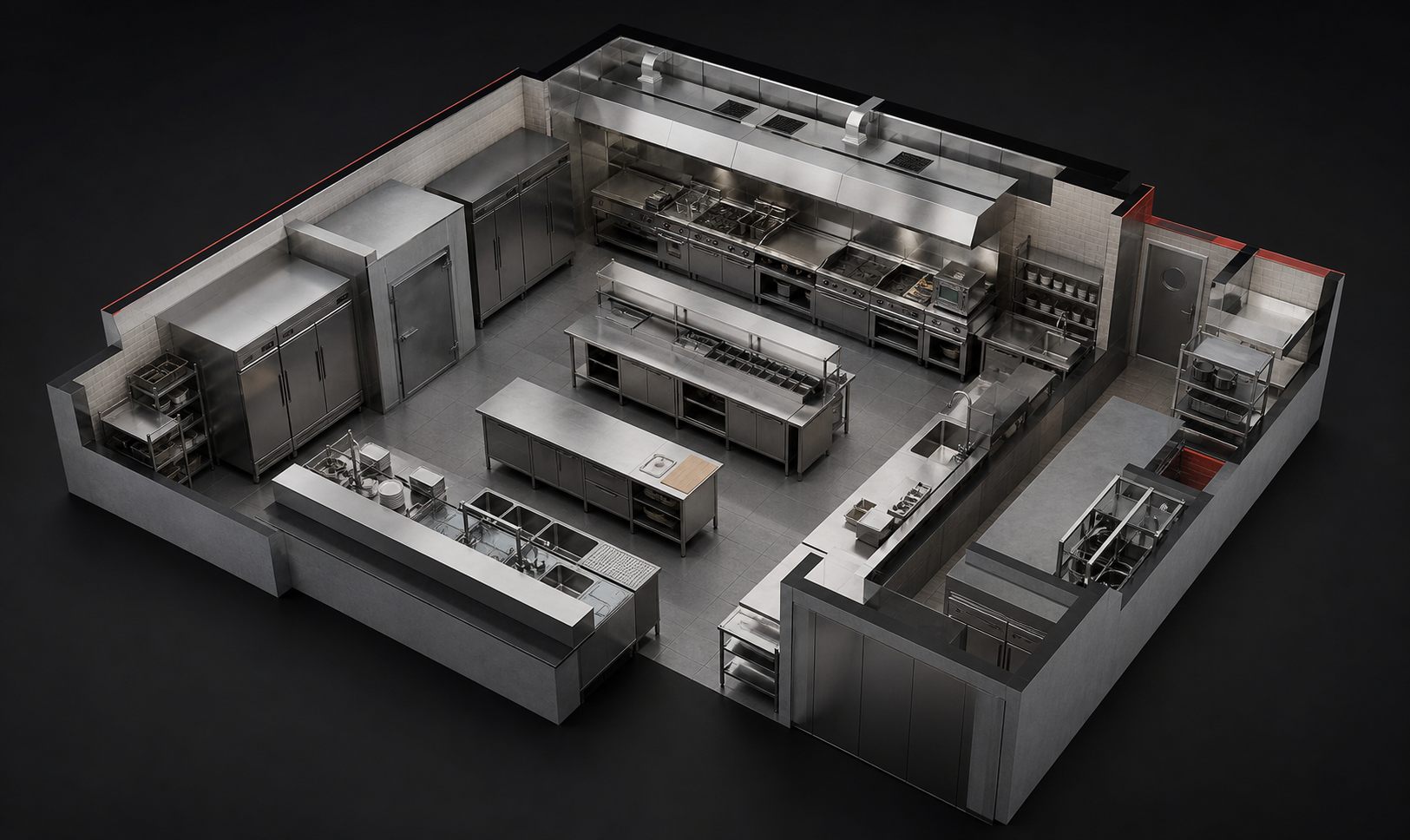
Organize the kitchen into operational zones
| Zone | Planning questions | Typical equipment categories |
|---|---|---|
| Receiving and storage | Delivery size, frequency, temperature and access | Shelving, cold rooms, refrigerators, freezers |
| Preparation | Ingredient flow, labor, batch size and cross-contamination controls | Worktables, sinks, cutters, mixers, processors |
| Cooking and baking | Menu method, peak output, extraction and utilities | Ranges, fryers, griddles, ovens, proofers |
| Holding and service | Holding time, service format and replenishment | Warmers, heated displays, buffet equipment |
| Warewashing | Peak rack volume, clean/dirty separation and drainage | Dishwashers, sinks, tables, racks |
| Support | Handwashing, waste, smallwares and maintenance access | Hand sinks, cabinets, trolleys, spare-parts storage |
Use the equipment schedule and layout together
An equipment schedule lists item number, description, model, quantity, dimensions, utility requirements and notes. The layout shows how those items relate to walls, doors, drains, ventilation, working aisles and service flow. Neither document is sufficient alone.
During preliminary planning, use verified outer dimensions where available and mark unconfirmed models. Leave maintenance and door-swing clearances. Confirm how large equipment will enter the building, including loading dock, corridors, elevators and final door openings.
A supplier layout can support equipment coordination, but it should not replace architectural, structural, mechanical, electrical, plumbing, fire or food-safety design by qualified local professionals. This distinction should be stated in project documents.
Create a utility matrix before final model selection
Short answer: Record voltage, phase, frequency, power, plug or hard-wiring, gas type and pressure, water, drainage, ventilation and heat rejection for every item. Compare the total with the building’s available services before purchase.
Electrical compatibility is a frequent cause of project delay. Confirm whether the site uses single- or three-phase power, the available voltages and frequency, and which items need dedicated circuits. A plug drawing does not replace electrical data.
Gas equipment requires local review of gas type, pressure, connection and ventilation. Water-using equipment requires flow, pressure, treatment and drainage information. Refrigeration and ice equipment can add heat to the room and may need ventilation clearances.
Ask for a consolidated utility schedule. This helps the local design team identify conflicts and avoids reviewing separate brochures with inconsistent units. Final connection and protection requirements should follow local codes and the model-specific manual.
Develop the equipment list by function
Food preparation
Select mixers, processors, slicers and preparation tables according to batch size, product characteristics, cleaning and operator skill. Confirm guards, attachments and food-contact components. Avoid specifying a machine only because it appears in a standard package.
Cooking and baking
Compare heat source, usable capacity, recovery, controls, ventilation and menu fit. A deck oven, convection oven and rotary rack oven solve different production problems. Fryer and griddle selections should use product load and peak output rather than tank or plate size alone.
Refrigeration
Define storage temperature, product volume, delivery frequency, door openings, ambient conditions and available remote or self-contained refrigeration options. Published capacity and performance must match the selected model and climate conditions.
Stainless steel and service equipment
Confirm dimensions, working height, bowl or shelf arrangement, wall conditions and material specification. Custom stainless-steel items require signed drawings before production because a small dimensional error can affect an entire line.
How should buyers evaluate a one-stop equipment supplier?
- Can the supplier explain which products are manufactured, sourced or customized?
- Are model-specific technical sheets available?
- Does the team separate confirmed values from pending values?
- Can electrical and utility information be consolidated?
- Are customization drawings and artwork approved before production?
- Is there a documented testing and shipment inspection process?
- Can packages be labelled against an equipment schedule?
- Are spare parts, manuals and warranty procedures explained?
- Does the supplier avoid unsupported certification and performance claims?
- Is there one responsible project contact for schedule changes?
Normalize quotations before comparing price
One-stop quotations are difficult to compare because suppliers may propose different capacities, accessories, materials, electrical versions and shipping scopes. Build a comparison sheet using one row per equipment item and columns for model, quantity, critical specifications, included accessories, packing, warranty, documents and exclusions.
Separate equipment price from optional customization, local installation, freight, destination charges and taxes. Confirm the trade term and shipment point. A low equipment total may exclude important items or use smaller configurations.
Request revisions through a controlled equipment schedule. When a model changes, update the item number, technical data, layout footprint and utility matrix together. Version control is especially important when several people participate in procurement.
Handle certifications and local requirements carefully
Certification requirements depend on product, model and destination. Ask for documentation that applies to the exact item. Do not accept a company management certificate as evidence that an individual machine meets a product safety standard.
Local health, fire, electrical, gas and building authorities may require specific materials, clearances, extraction, backflow protection or installation methods. The buyer should confirm those requirements with local professionals before approving the final equipment list.
Where certification is pending, state it clearly. Changing the required standard late in the project can affect components, cost and lead time.
Coordinate production, customization and factory testing
Customized items should have an approval record: drawings, finish, logo, voltage, plug, accessories, labels and packaging marks. Approval should occur before production and should identify which dimensions are critical to the site.
Testing varies by product. Heating equipment may require heating and temperature checks; refrigeration may require cooling and stability checks; mixers may require running, speed and guard checks. Ask for model identification in photographs or videos so evidence can be matched to the order.
A final inspection should compare the equipment schedule, purchase order and packing list. It should verify quantities, model plates, visible condition, accessories and custom details. Inspection does not replace correct engineering, but it can identify many shipment errors before they become destination problems.
Plan consolidated packing and shipment identification
A multi-category order may contain dozens of packages. Create a package identification system linked to equipment item numbers. Labels should remain visible after protective wrapping and should include package count where an item ships in multiple cases.
Confirm packing method and dimensions after final packing. Accessories should be secured and listed. Fragile controls, glass and protruding components need appropriate protection. Photograph the equipment before and after packing.
For container planning, use verified package dimensions and weights. Loading quantity should not be promised before the package data and container plan are confirmed. At destination, provide the receiving team with packing list, item map and instructions for reporting damage.
Prepare the site before equipment delivery
- Confirm final model dimensions and service clearances
- Complete power, gas, water, drainage and ventilation points
- Verify doorway, corridor, elevator and lifting access
- Assign qualified local installers
- Check floor strength, level and finish
- Prepare isolation devices and connection materials
- Review manuals before commissioning
- Inspect all packages for transit damage
- Record model and serial information
- Test equipment systematically before opening
Use decision gates instead of a vague delivery date
A practical project schedule includes brief approval, preliminary list, model confirmation, utility review, drawing approval, deposit, production, inspection, final packing data, shipment, site readiness and commissioning. Each gate has an owner and required documents.
Lead time should start from a defined event, such as receipt of deposit and approval of all technical and customization details. Changes after approval can affect both production and consolidated shipment timing.
Plan buffer for local review, freight, customs and installation. Avoid making an opening date depend on the most optimistic transit estimate.
Evaluate lifecycle cost, spare parts and service access
Purchase price is only one part of project cost. Consider energy and water demand, cleaning labor, consumables, planned maintenance, replacement parts, downtime and the availability of qualified local service. A complex feature has little value if the operating team cannot maintain it or obtain the required parts.
Ask the supplier to identify recommended spare parts for commissioning and the first operating period. The answer should be product specific: door seals, switches, contactors, heating components, thermostats, belts, bearings, blades or refrigeration controls may be relevant to different categories. Do not buy a generic spare-parts package that cannot be matched to item numbers.
Create an asset register during procurement. Record equipment item number, manufacturer, model, serial number, utility, warranty date, manual, supplier contact and installed location. Photograph nameplates after installation. This simple record helps operators request the correct part instead of sending an unclear machine photograph months later.
Warranty terms should define what is covered, the period, required evidence, exclusions, parts shipment and responsibility for local labor or travel. Overseas equipment warranties frequently differ from domestic service contracts, so buyers should clarify the practical claim process before ordering.
Plan receiving, commissioning and project handover
When the shipment arrives, inspect the container or external packages before unloading and record any visible damage. Count packages against the packing list, then move them to a protected receiving area. Do not discard packaging until equipment condition and accessories have been checked.
Commission equipment in a controlled sequence. Verify model, voltage, gas type and connections before power-up. Confirm that protective materials and transport restraints are removed, then follow the model-specific manual. Test safety functions and basic operation before recipe or full-load trials. Qualified local technicians should handle electrical, gas, water, drainage and ventilation connections.
Handover should include manuals, drawings, utility data, test records, warranty information, spare-parts list and staff training notes. Assign responsibility for daily cleaning, periodic inspection and service escalation. A signed punch list can record incomplete documents, transit issues and adjustments without delaying the entire opening process.
After the first operating weeks, review whether capacities and workflows match the original assumptions. This is useful feedback for future expansion and helps distinguish an equipment problem from a menu, staffing or scheduling issue.
One-stop kitchen project RFQ checklist
- Business type, menu and service model
- Seats, covers, peak orders or production target
- Operating hours and delivery frequency
- Existing floor plan with dimensions
- Destination country and project location
- Voltage, phase, frequency and gas type
- Water, drainage and ventilation information
- Required equipment categories and preferred brands or models
- Local certification or material requirements
- Custom stainless-steel and branding needs
- Target budget range and required opening date
- Shipping term and destination port
- Required drawings, manuals, tests and inspection records
Frequently asked questions
What information is needed for a complete restaurant equipment quotation?
Provide the menu, service model, peak demand, floor plan, destination, utilities, required equipment categories, local requirements, budget and timeline. Mark assumptions where details are not final.
Can one supplier design the complete kitchen?
A supplier can coordinate equipment selection and a preliminary equipment layout. Final architectural, structural, MEP, fire and code design should be completed or approved by qualified local professionals.
How do I compare one-stop kitchen quotations?
Normalize each item by model, capacity, dimensions, utilities, accessories, customization, packing, warranty, documents and exclusions. Compare scope before total price.
What should be inspected before shipment?
Check item count, models, nameplates, electrical versions, visible condition, accessories, custom details, manuals and packing labels against the approved equipment schedule.
Should certification be confirmed before ordering?
Yes. Required certifications must be confirmed for each exact model and destination. Do not rely on generic supplier claims or unrelated company certificates.
When should installation planning start?
Installation planning should begin during model selection, because dimensions, clearances and utilities affect the building work. Do not wait until the equipment is shipped.
Conclusion
A one-stop commercial kitchen package is valuable when it reduces interfaces between menu planning, equipment selection, utilities, customization, inspection and logistics. It should produce a controlled equipment schedule—not a generic bundle.
The buyer still needs local professional review and disciplined approvals. When every item is connected to a process, site condition and verified specification, the project team can compare quotations more fairly and prepare the kitchen before the shipment arrives.