
Commercial Equipment Buyer's Guide
How to Choose a Commercial Planetary Mixer: A Practical Buyer’s Guide
A procurement-focused guide to bowl capacity, real batch size, attachments, drive systems, voltage, safety, testing, shipping and installation preparation.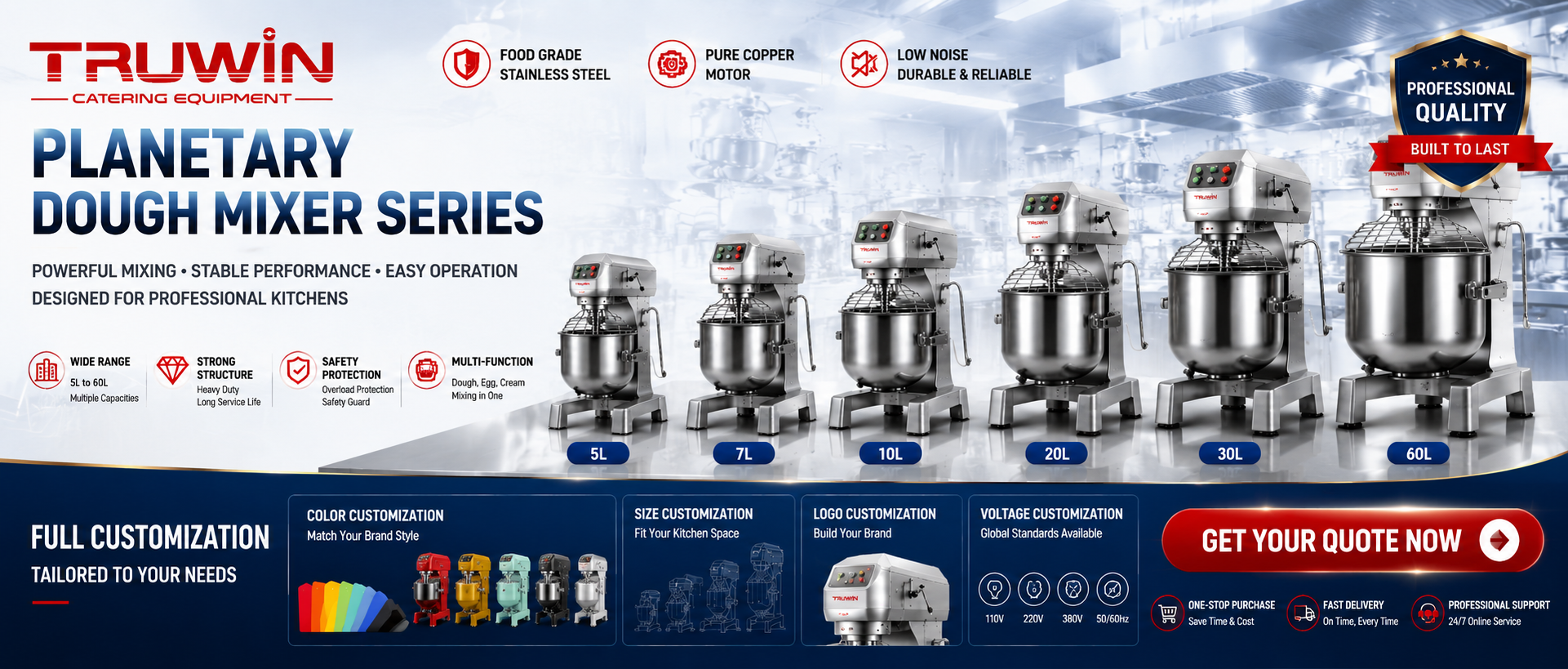
A procurement-focused guide to bowl capacity, real batch size, attachments, drive systems, voltage, safety, testing, shipping and installation preparation.
Reviewed by Product and Export Coordination Team. Technical values and claims must be confirmed against the selected product model and destination requirements.What should a buyer check first?
Short answer: Choose a commercial planetary mixer by the product you will mix, the working batch size—not only the nominal bowl volume—the required attachments, duty cycle, available electrical supply, safety arrangement, cleaning method and local installation conditions. Request a model-specific technical sheet before comparing prices.
A planetary mixer can perform several preparation tasks because the mixing tool rotates on its own axis while moving around the bowl. That versatility makes it common in bakeries, hotel kitchens, restaurants, cake shops and catering operations. It also creates a purchasing risk: two machines with the same bowl label may have different usable loads, motor characteristics, transmission designs, speeds, attachments and protection systems.
The correct purchasing process therefore starts with the recipe and production plan. A buyer should define the products, ingredient weight per batch, number of batches during the busiest hour, mixing time, dough or batter consistency, available voltage and cleaning routine. Only then should the buyer compare models and quotations.
Planetary mixer or spiral mixer: which type fits the job?
Short answer: Use a planetary mixer when flexibility across batter, cream, egg, icing and moderate dough preparation matters. Consider a spiral mixer when bread or pizza dough is the dominant high-volume task. Neither type is automatically better; the production mix determines the correct choice.
| Decision factor | Planetary mixer | Spiral mixer |
|---|---|---|
| Typical work | Cream, batter, egg, fillings and mixed preparation | Bread and pizza dough production |
| Tools | Interchangeable attachments | Spiral hook and rotating bowl arrangement |
| Buying focus | Attachment set, speed, bowl lift and guard | Dough capacity, hydration, bowl movement and duty cycle |
| Best fit | Multi-product bakery or commercial kitchen | Dough-focused bakery, pizzeria or production line |
Start with the product application, not the mixer label
Before asking for a price, list every product expected from the mixer. A cake shop may need whisking for sponge batter, creaming for fillings and limited dough mixing. A pizzeria may care mainly about dough consistency and repeatable batch timing. A hotel kitchen may need a flexible machine that changes tasks several times a day. These are different duty profiles even when the buyer initially asks for the same 30L mixer.
Send the supplier a short application sheet. Include the recipe category, approximate ingredient weight, hydration or viscosity where relevant, target batches per hour, ambient conditions and whether the machine will run continuously or intermittently. This information allows the supplier to confirm whether a planetary configuration is suitable or whether a spiral mixer should be considered.
Avoid unsupported claims such as 'suitable for every dough.' Dense dough can impose a much higher load than cream or batter. A responsible quotation should distinguish bowl volume from recommended working capacity and should state that final loads depend on the recipe and tool.
How do bowl volume and working capacity differ?
Short answer: Bowl volume is a geometric volume, while working capacity is the amount that can be processed under defined recipe and operating conditions. A 30L bowl does not mean that every product can be mixed at a 30 kg load.
Nominal bowl capacity is useful for identifying a product series, but it is not a universal production rating. Flour, dough, whipped cream and batter occupy the bowl differently and place different torque demands on the drive system. The selected attachment, mixing speed and ingredient temperature also affect the practical load.
For planning, calculate the required batches from peak demand. If a bakery needs 90 kg of a product during a three-hour production window, a theoretical average is 30 kg per hour. That number still does not select a mixer. The buyer must add mixing time, loading and unloading, bowl scraping, cleaning, recipe changes and reasonable operating margin. Ask the supplier to state the tested batch recommendation for the actual recipe rather than converting litres directly into kilograms.
A useful specification request separates bowl volume, recommended flour load, recommended dough load for a stated hydration range, liquid or cream guidance and maximum continuous operating guidance. If the supplier cannot verify those values, mark them for confirmation instead of treating a marketplace title as technical evidence.
Evaluate the motor and transmission as a system
Motor power alone does not describe mixing performance. The transmission, gear ratios, speed selection, shaft design and protection system determine how power reaches the attachment. A machine with a larger motor rating is not necessarily the better choice if the transmission is poorly matched to the intended load.
For a gear-drive planetary mixer, ask how many operating speeds are available, whether speed changes require the machine to stop, what protection is provided against overload and which components are considered routine service parts. Confirm whether the quoted power is input power, rated motor power or another figure. These terms are often used inconsistently in listings.
Noise and vibration should be observed during factory testing. A no-load run can reveal obvious mechanical irregularities, but a loaded mixing test is more meaningful. The loaded test should use a product or test load appropriate to the model and should not be represented as proof for every possible recipe.
Confirm the attachment set and its intended tasks
Planetary mixers are usually purchased for their attachment flexibility. Common tool categories include a whisk for aeration, a beater or paddle for batter and cream, and a dough hook for dough preparation. Names, shapes and included quantities vary by model, so the purchase contract should list each attachment rather than relying on a product photo.
Check the attachment material, connection method, cleaning instructions and whether spare tools can be ordered later. A buyer serving an allergy-sensitive operation should also consider the workflow for cleaning between recipes. If the application depends on a special tool, request a drawing or clear photograph before production.
Attachments must also match the operating speed. High-speed whisking and low-speed dough work impose different loads. Operators should follow the model-specific manual and should not assume that every attachment is safe at every speed.
Review the bowl, guard and operating controls
The bowl should be easy to position, secure and remove according to the intended workflow. Ask whether the bowl is supplied with handles, how it is raised or lowered, and what clearance is needed for removal. Material grade should be confirmed from product documentation when it matters to a project; a visual stainless-steel appearance is not proof of a specific grade.
The safety guard should be assessed as a functional component, not a decorative wire frame. Confirm whether the guard is removable, whether an interlock is fitted, and how the interlock behaves when the guard or bowl is not in the operating position. Final requirements can differ by destination market and model.
Controls should be understandable to the intended operators. Ask about start, stop, timer and emergency behavior, and whether labels can be localized. For kitchens with frequent staff changes, simple controls and a clear operating procedure can be more valuable than unnecessary automation.
Match voltage, frequency and plug before ordering
Short answer: The mixer’s voltage, phase, frequency and plug must match the installation site. A plug shape alone does not confirm electrical compatibility.
International buyers should send a photograph or written specification of the available supply: voltage, single- or three-phase service, frequency, outlet or isolation method and local plug requirement. The supplier should return the confirmed nameplate configuration in the quotation or technical sheet.
Do not assume that a 220V listing is suitable for every 220–240V market. Frequency can affect motor behavior, and plug or cable requirements may be governed by local rules. Higher-capacity machines may require hard wiring or a dedicated circuit rather than a household-style plug. Installation should be reviewed by a qualified local electrician.
Before shipment, nameplate information, cable, plug and control configuration should be included in shipment inspection. A simple photograph of the nameplate next to the order reference can prevent costly installation delays.
Plan cleaning and changeover before the machine arrives
Cleaning time affects real production capacity. Evaluate which food-contact components can be removed, whether the guard can be accessed without tools, where product may accumulate and whether the exterior can be wiped without exposing electrical parts. The operating manual should distinguish washable components from areas that must remain dry.
The installation location needs clearance for bowl removal, ventilation where required, operator movement and maintenance access. Measure doors, elevators and passages between the unloading point and final position. A machine that fits the floor plan may still fail to pass through a doorway in its shipping package.
For multi-recipe operations, create a changeover sequence before commissioning. Define which tools and bowls are dedicated, how cleaned parts are stored and how operators confirm that the correct tool is locked before starting.
What factory testing should be requested?
Short answer: Request documented checks that match the model: appearance inspection, no-load running, loaded mixing where appropriate, speed operation, guard function, timer or control check, noise and vibration observation, electrical safety checks and final nameplate verification.
Factory testing should be described accurately. A short video showing the machine running is useful, but it is not the same as a formal performance test. Ask the supplier to identify the model, voltage and order reference in the test record. Where a loaded test is performed, the load and duration should be stated.
A practical shipment inspection also confirms the bowl, attachments, guard, manual, cable or plug, spare parts and branding. Inspectors should compare quantities with the packing list and photograph the machine before protective film and final packaging conceal important details.
Do not request certificates that are unrelated to the model or destination. Certification availability must be confirmed against the exact product record. Company-level management certificates should not be treated as product safety certification.
Prepare shipping and installation information early
The commercial quotation should identify packing method, package dimensions, net and gross weight, lead time and available shipping terms once verified. These values affect freight, destination handling and doorway planning. If final data is not available at the first inquiry, it should be listed as pending confirmation—not estimated without a basis.
Before dispatch, confirm moisture protection, foam or structural protection, export carton or wooden case requirements, accessory packaging and shipping marks. Photograph the packed machine and record package dimensions after packing. For consolidated kitchen projects, label every package against the equipment schedule so the receiving team can identify items without opening all cases.
Installation preparation should include electrical supply, floor condition, working clearances, lifting or handling plan and responsible local technician. Commissioning should begin with inspection for transit damage, verification of supplied parts and review of the manual before powered testing.
How should buyers compare mixer quotations?
Compare quotations line by line. The model name and bowl volume are only the beginning. Normalize the application, tested load, attachment set, electrical configuration, guard arrangement, controls, material claims, packing, warranty scope, spare parts and documentation. A lower price may simply exclude an attachment, different electrical configuration or stronger export packaging.
Ask who will confirm the technical specification and how changes are controlled. If logo, color or packaging customization is required, request artwork approval and a clear boundary between standard and customized parts. Keep final approved specifications, photographs and drawings with the purchase order.
A useful supplier response explains what is confirmed, what depends on the destination, and what still requires verification. Overconfident answers without model-specific evidence should be treated cautiously.
Commercial planetary mixer RFQ checklist
- Products and recipes to be mixed
- Ingredient or dough weight per batch
- Peak batches per hour and daily operating time
- Required bowl volume or current machine reference
- Required attachments and spare attachments
- Voltage, phase, frequency and plug or wiring method
- Destination country and destination port
- Logo, color and packaging requirements
- Required product documents and language
- Target order quantity and purchase timeline
- Doorway, elevator or site-access limits
- Requested factory test and shipment inspection evidence
Common purchasing mistakes to avoid
- Selecting only by nominal bowl litres
- Using motor power as the only performance indicator
- Assuming every planetary mixer is intended for dense dough
- Failing to list attachments in the quotation
- Confirming plug type but not voltage, phase and frequency
- Using unverified certification claims
- Ignoring packed size and access to the installation area
- Comparing prices without normalizing included parts and testing
- Skipping nameplate and accessory checks before shipment
Frequently asked questions
Is a 30L planetary mixer suitable for a bakery?
It can be suitable for bakeries that need flexible mixing for batter, cream, egg, fillings and certain dough tasks. The correct working load must be confirmed for the recipe, attachment and duty cycle; 30L is the bowl volume, not a universal 30 kg capacity.
Can a planetary mixer make pizza dough?
Some planetary mixers can prepare pizza dough within model-specific load limits. A dough-focused operation with frequent or heavy batches may be better served by a spiral mixer. Share dough weight, hydration and batches per hour before selection.
Which attachments should be included?
A typical commercial set may include a whisk, beater or paddle, and dough hook, but the exact tools and quantities must be written into the quotation and packing list.
What voltage information should an overseas buyer provide?
Provide voltage, phase, frequency, plug or hard-wiring requirement, destination country and any local electrical constraints. The final nameplate should be checked before shipment.
What should be checked during factory testing?
Applicable checks include no-load running, loaded mixing, speed operation, guard function, controls, noise and vibration observation, electrical safety and final appearance. Test scope varies by model and configuration.
How can I request an accurate quotation?
Send the product application, batch weight, required quantity, voltage, frequency, plug, destination and customization needs. Ask the supplier to identify all unconfirmed technical values.
Conclusion
Choosing a commercial planetary mixer is a production-planning decision, not a comparison of bowl labels. Define the recipes and peak workload, then verify working capacity, attachments, transmission, electrical configuration, safety, cleaning, testing and packing against a model-specific technical sheet.
For international procurement, the most valuable supplier behavior is disciplined confirmation: clear answers where evidence exists and clear 'to be confirmed' markers where it does not. That approach reduces installation delays and gives the buyer a reliable basis for comparing quotations.